
Tag: Assessment Practices

Evaluating & Assessing Academic-Return on Investment with EdTech

Everyone everywhere always wants “the biggest bang for their buck” possible. Responsible allocation of public funds may not be your most exciting job description, yet it is probably one of your most important responsibilities.

Taxpayers and other stakeholders deserve evidence that school district leaders spend money wisely. Communicating every dollar is allocated into learning inspires trust among community members. Hopefully, this confidence translates into increased engagement and voting on district issues.

Most people don’t understand the complexities of district budgeting; however, they are likely familiar with the concept of return on investment. Academic-Return on Investment, or A-ROI, builds on that familiar model.

A-ROI is a great way to demonstrate the cost-effectiveness of educational expenditures. You can read about A-ROI in-depth in the publication, Spending Money Wisely. It shows the formula for A-ROI as:

(Learning increase) x (# of students helped)

_________________________________________

$ spent

Essential considerations for A-ROI require answering questions such as:

  1. What programs and strategies are successful, and how can we expand those successes to more students?
  2. What programs and strategies are failing to show the desired results? Are there any reasons not to eliminate associated expenses?
  3. What are the most cost-effective ways to help struggling students?
  4. Where can we reduce costs without negatively impacting students?

Answering these questions and acting on the information provides evidence of responsible budgeting.

How EdTech Improves Student Learning

On a per-student cost basis, EdTech is often an excellent investment. Some software programs are designed for the student to interact with directly. These programs often provide immediate growth-producing feedback and engage students with a game-like model. Some EdTech programs aim to help educators boost efficiency. The EdTech software with the highest A-ROI helps students learn and streamlines the workload.

Helping teachers work efficiently increases student learning because they can devote more energy to differentiation and instruction. Our eight pillars of success will help you explore potential areas for improving instruction and efficiency. EdTech platforms offered by Harris Education Solutions help teachers in the following ways:

  • Seeing which students need remediation and acceleration and in what areas
  • Automatically grading assignments and tests
  • Making it easy to create assignments and tests that align with standards and state assessments
  • Collaborating with colleagues
  • Communicating with students and their families
  • Inputting and finding student information
  • Creating various versions of any assignment to allow for accommodations and differentiation
  • Sending work to absent students
  • Providing engaging practice for some students while the teacher works with other students
A Sample Scenario of Using A-ROI for Evaluating Software

Let’s imagine that your district is piloting two software programs, and you want to evaluate them for A-ROI. For the sake of simplicity, let’s say that you test both programs with ten math teachers with an average of 75 students each. Software program X helps math teachers save ten hours per year. These extra planning hours raise math scores by 5%. Software X costs $300 per license.

Software program Y helps math teachers save 10 hours, provides data to drive instruction, and gives students helpful practice. Students’ math scores go up 10%. Software Y costs $350 per license.
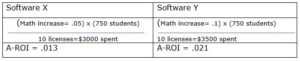
Despite costing more per license, Software Y has a significantly better A-ROI.

Valuing Educator Time as a Strong A-ROI

In addition to more time for planning and collaborating, another benefit of investing in work efficiency is that it enhances morale. Menial tasks make teachers feel that the districts do not appreciate their expertise. Feeling undervalued often contributes to teacher attrition. Since hiring and training new teachers costs considerably more than retaining highly qualified teachers, it behooves district leaders to provide them with time-saving tools.

Using EdTech to Assess A-ROI

Not only can you use A-ROI to assess your EdTech, but you can also use EdTech to evaluate the A-ROI of other programs. The A-ROI formula appears deceptively simple. The challenge lies in collecting information to put into the formula. Many administrators explain that software platforms’ ability to help assess A-ROI is where the platforms shine.

EdTech software such as Castle LearningeDoctrinaedInsight, and eWalk help measure learning. They also make it easy to aggregate and disaggregate data, analyze the information, and share it with others. The platforms allow administrators to see the effect size of various programs by segmenting student populations. These robust capabilities make answering questions about A-ROI possible.

You might want to pilot two different strategies before deciding on one and expanding it. For example, you might try reducing class sizes for half the fifth graders in the district and free after-school tutoring for the other half. Using the data software programs, you can look at the fifth-grade groups to see how many students benefitted, to what degree, and for what price. You will then have meaningful information to feel confident in making the best decision about expansion.

Ask Educators

While A-ROI provides important numerical information, educators’ experiences about EdTech solutions provide valuable insight too. Ask teachers and principals for details about how different programs changed their workday and advanced student learning.

EdTech Solutions as a Tool to Help People

Teachers inspire, encourage, and educate our future leaders. District leaders provide the tools for teachers to thrive. At Harris Education Solutions, we develop EdTech to help educators support student success. Take our Solutions Tool survey to discover the platform that best meets your A-ROI goals.

Ideas for Maintaining Academic Integrity in High School with Distance Learning

Whether teaching face-to-face or remotely, upholding academic integrity in high school takes a consistent and multi-pronged approach. Polls show that more than 50 percent of high school students take unethical academic shortcuts at least once in high school, and some do it much more frequently. The International Center for Academic Integrity says on its website:

McCabe’s surveys of over 70,000 high school students at over 24 high schools in the United States demonstrated that 64 percent of students admitted to cheating on a test, 58 percent admitted to plagiarism, and 95 percent said they participated in some form of cheating, whether it was on a test, plagiarism or copying homework.

Plagiarism and cheating undermine the assessments’ value. Even copying homework has negative consequences. Students taking shortcuts often do not bother to learn foundational material and then struggle with subsequent concepts. Finally, cheating is unfair to the students who earn their grades.

Students cheat when three criteria are met. 1) The students consider cheating only mildly ethically problematic. 2) The rewards outweigh the risks. 3) Cheating is easier than doing the work.

The first two conditions do not change with remote versus face-to-face learning, but the third one does change. The inherent difficulty of monitoring students during distance learning makes maintaining academic integrity more challenging. Addressing all three conditions helps them stay academically honest in any learning environment.

Encourage Academically Ethical Behavior

Cheating has become so normalized that even students who consider themselves as honest individuals admit that they cheat.  In surveys, these students say that cheating does not diminish their view of their own overall integrity.  Many teachers find that directly addressing the ethics of cheating reduces the rate. You can implement the following ideas remotely or in person:

  1. Set the expectation that most students are academically honest and explain that you will put in safeguards to encourage that behavior.
  2. Explicitly explain what constitutes cheating and how to avoid it.
  3. Discuss academic integrity in class and ask students to express how they feel when they hear of classmates cheating. High school students are sensitive to peer pressure and therefore are less likely to cheat when they think their friends will judge them negatively.
  4. Ask students to sign an honor code. Honor codes are simple and surprisingly effective. Signing their name to a promise to have academic integrity makes it harder for students to see themselves as honest if they breach it.
Change the Risk Versus Reward Ratio

High school students are often under immense pressure to get high grades. Good grades open opportunities for scholarships and more prestigious colleges. The rewards that come from a high GPA change the goal of high school for many students (and their parents). Instead of working for the purpose of learning, they work to get an A.

Students may feel tempted to cheat if they can get an A without spending hours studying. A poll at Fordham University found cheaters boast a 3.41 GPA, while non-cheaters average 2.85. Making the risk of getting caught not worth the reward of getting a better grade deters academic dishonesty. Try the following few strategies to increase the risk of getting caught and decrease the stakes of each grade and evaluation:

  1. Assess students frequently. Computer-based assessments such as those from Castle Learning and eDoctrina make creating and grading assessments easier.
  2. Break large projects and essays into smaller pieces with interim due dates. This practice guides students with pacing and helps them build a solid foundation. Grading each component also dilutes the value of the final grade to reduce the benefit of copying.
  3. Post the repercussions for academic dishonesty.
  4. Emphasize learning and cooperation over competition and grades.
  5. Report any suspicion of academic misconduct to your administrator to investigate.
  6. Closely monitor students during tests. If you are teaching remotely, you can monitor by asking them to keep their cameras on and using a Chromebook monitoring software.
Make Cheating Harder than Doing the Work Honestly

Sometimes students cheat because they want good grades without investing the necessary time and effort to study. However, the motivation disappears if learning is easier than cheating. Then they must choose between doing the work or getting an unsatisfactory grade. Hopefully, they decide to study, but either way, they are staying academically honest.  The following suggestions either make cheating more difficult or doing well on the assessment easier:

  1. Deter students from sharing answers with each other. Use a large bank of questions and then create multiple versions of the test. If you don’t have a large enough bank to create completely different test questions, randomize the order of questions. Collecting a large bank of questions is much easier if you are using Castle Learning or eDoctrina. These platforms allow you to share test questions with other teachers and provide questions for many standards.
  2. Allow a specific window of time for taking the test so students can’t take the test and then tell their friends the answers. Use the settings on computer-based assessment platforms to allow specific access windows for students taking the test remotely.
  3. Do not let anyone see feedback on specific questions until the window for taking the exam closes.
  4. If possible, lockdown student browsers when they take tests.
  5. Use remote proctoring software. Be sure to do a trial run before the actual test.
  6. Use some open-ended questions with higher-order thinking skills, not just factual recall.
  7. Assign paper topics that would be hard to buy from a commercial paper mill, such as myessaywriter.net
  8. Use a plagiarism checker.
  9. Allow “open book” tests and ask questions that require personal reflection and applying knowledge.
  10. Use clear rubrics and guidelines for the course, so everyone knows what to expect and how to study.
  11. Help students prepare by providing study guides, vocabulary handouts, and copies of old exams or sample essays.
  12. Show students how to cite sources and give credit to original ideas.
  13. Before any significant test, make time for answering questions and giving extra help. If you are teaching remotely, you can do this by setting up virtual office hours.

Following these tips will help students develop good habits and support academic honesty whether they are learning remotely or in person. Castle Learning and eDoctrina from Harris Education Solutions make giving computer-based assessments easier and help encourage student integrity.