
Author: HES Marketing

Evaluating & Assessing Academic-Return on Investment with EdTech

Everyone everywhere always wants “the biggest bang for their buck” possible. Responsible allocation of public funds may not be your most exciting job description, yet it is probably one of your most important responsibilities.

Taxpayers and other stakeholders deserve evidence that school district leaders spend money wisely. Communicating every dollar is allocated into learning inspires trust among community members. Hopefully, this confidence translates into increased engagement and voting on district issues.

Most people don’t understand the complexities of district budgeting; however, they are likely familiar with the concept of return on investment. Academic-Return on Investment, or A-ROI, builds on that familiar model.

A-ROI is a great way to demonstrate the cost-effectiveness of educational expenditures. You can read about A-ROI in-depth in the publication, Spending Money Wisely. It shows the formula for A-ROI as:

(Learning increase) x (# of students helped)

_________________________________________

$ spent

Essential considerations for A-ROI require answering questions such as:

  1. What programs and strategies are successful, and how can we expand those successes to more students?
  2. What programs and strategies are failing to show the desired results? Are there any reasons not to eliminate associated expenses?
  3. What are the most cost-effective ways to help struggling students?
  4. Where can we reduce costs without negatively impacting students?

Answering these questions and acting on the information provides evidence of responsible budgeting.

How EdTech Improves Student Learning

On a per-student cost basis, EdTech is often an excellent investment. Some software programs are designed for the student to interact with directly. These programs often provide immediate growth-producing feedback and engage students with a game-like model. Some EdTech programs aim to help educators boost efficiency. The EdTech software with the highest A-ROI helps students learn and streamlines the workload.

Helping teachers work efficiently increases student learning because they can devote more energy to differentiation and instruction. Our eight pillars of success will help you explore potential areas for improving instruction and efficiency. EdTech platforms offered by Harris Education Solutions help teachers in the following ways:

  • Seeing which students need remediation and acceleration and in what areas
  • Automatically grading assignments and tests
  • Making it easy to create assignments and tests that align with standards and state assessments
  • Collaborating with colleagues
  • Communicating with students and their families
  • Inputting and finding student information
  • Creating various versions of any assignment to allow for accommodations and differentiation
  • Sending work to absent students
  • Providing engaging practice for some students while the teacher works with other students
A Sample Scenario of Using A-ROI for Evaluating Software

Let’s imagine that your district is piloting two software programs, and you want to evaluate them for A-ROI. For the sake of simplicity, let’s say that you test both programs with ten math teachers with an average of 75 students each. Software program X helps math teachers save ten hours per year. These extra planning hours raise math scores by 5%. Software X costs $300 per license.

Software program Y helps math teachers save 10 hours, provides data to drive instruction, and gives students helpful practice. Students’ math scores go up 10%. Software Y costs $350 per license.
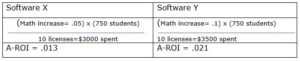
Despite costing more per license, Software Y has a significantly better A-ROI.

Valuing Educator Time as a Strong A-ROI

In addition to more time for planning and collaborating, another benefit of investing in work efficiency is that it enhances morale. Menial tasks make teachers feel that the districts do not appreciate their expertise. Feeling undervalued often contributes to teacher attrition. Since hiring and training new teachers costs considerably more than retaining highly qualified teachers, it behooves district leaders to provide them with time-saving tools.

Using EdTech to Assess A-ROI

Not only can you use A-ROI to assess your EdTech, but you can also use EdTech to evaluate the A-ROI of other programs. The A-ROI formula appears deceptively simple. The challenge lies in collecting information to put into the formula. Many administrators explain that software platforms’ ability to help assess A-ROI is where the platforms shine.

EdTech software such as Castle LearningeDoctrinaedInsight, and eWalk help measure learning. They also make it easy to aggregate and disaggregate data, analyze the information, and share it with others. The platforms allow administrators to see the effect size of various programs by segmenting student populations. These robust capabilities make answering questions about A-ROI possible.

You might want to pilot two different strategies before deciding on one and expanding it. For example, you might try reducing class sizes for half the fifth graders in the district and free after-school tutoring for the other half. Using the data software programs, you can look at the fifth-grade groups to see how many students benefitted, to what degree, and for what price. You will then have meaningful information to feel confident in making the best decision about expansion.

Ask Educators

While A-ROI provides important numerical information, educators’ experiences about EdTech solutions provide valuable insight too. Ask teachers and principals for details about how different programs changed their workday and advanced student learning.

EdTech Solutions as a Tool to Help People

Teachers inspire, encourage, and educate our future leaders. District leaders provide the tools for teachers to thrive. At Harris Education Solutions, we develop EdTech to help educators support student success. Take our Solutions Tool survey to discover the platform that best meets your A-ROI goals.

Taking Time for Self-Care Helps Everyone

If you feel tired, irritable, apathetic, or forgetful, you may be showing signs of burning out. You are not alone; this year exhausted many teachers and administrators. Be aware that the negative feelings can create a downward spiral making it hard to motivate yourself to do activities that will help you feel better. Educators give a lot of themselves, sometimes to such a degree that they forget to schedule time for themselves.  At Harris Education Solution, we support educators doing amazing work to support students. We hope this list of self-care ideas inspires you to do something for yourself today.

This next part is for you if you are saying to yourself, “Sure, I would love some ‘me-time,’ but I don’t have time for it.” Set boundaries and sometimes say “no” to requests and invitations so you can say “yes” to more free time and less stress. A daily routine with positive habits can make a big difference in your mental, physical, and emotional health. You can start small and add a few habits that make you feel better. Below is a list of ideas to get you started. The list is organized by time commitment so that you can work up from your current routine.

Less than a Minute
  • Examine your thoughts and reframe any negative self-talk with a more positive perspective. Turn “I failed at something” into “I challenged myself and gave myself a learning opportunity.”
  • Give someone a long hug.
  • Breathe deeply.
  • Drink a glass of water.
  • Energize yourself with some quick exercises like running up the stairs or doing a few push-ups.
  • Adjust your posture and relax any tense muscles.
  • Smile or laugh to trick your brain into feeling happier.
  • Give someone a sincere compliment.
  • Light a candle or use an essential oil diffuser with a scent that you enjoy. Be aware that not everyone takes pleasure from the same fragrances, and oils can cause reactions for some people. Many schools have rules against using them in the school building.
  • Give yourself a hand massage while putting lotion on. 
Less than Twenty Minutes
  • Meditate.
  • Connect with your spiritual side.
  • Start or write in a gratitude journal.
  • Eat a healthy snack.
  • Take a power nap.
  • Organize a small area that has been bugging you. The space you inhabit affects your mood and improving it will bring a smile to your face.
  • Sit outside.
  • Buy or cut a bouquet of flowers for your home.
  • Replace a burnt-out lightbulb or do some other neglected chore to feel a sense of accomplishment.
  • Look at pictures from a happy time.
  • Dream about what you will do when you have more time and take one step towards making that happen.
  • Listen to your favorite music.
  • Cuddle with your pet or a loved one.
  • Write out and prioritize a to-do list. Look for responsibilities that you can delegate or eliminate. Remember to add and prioritize a self-care item to your list. 
An Hour or Two
  • Immerse yourself into singing, dancing, coloring, drawing, playing a musical instrument, or whatever creative activity calms you and induces a relaxed mental flow.
  • Enjoy a long bath or shower.
  • Get a massage.
  • Catch up on sleep by taking a nap, going to bed early, or sleeping in late. Getting enough sleep is critical to cognitive function, emotional regulation, and overall health.
  • Put away your cell phone and computer, or at least turn off notifications. These interruptions cause unnecessary stress.
  • Escape into a good story with a book or movie.
  • Moving your body has excellent health and mental benefits. Starting to exercise when you are out of the habit is hard, but the reward is worth it. Choose the workout routine that you enjoy most. It can be as simple as going for a walk. Consider asking a friend to be your workout partner to help keep you motivated.
  • Visit with a friend or family member who has a positive outlook and makes you laugh. If your relationships have withered from working too much, this is a great time to meet new people. Perhaps try volunteering, joining a club, or attending a place of worship. A good support network will help you through the toughest of times.
  • Get rid of excess clutter. Donate, sell, or throw away items that you have not used recently. Look to Marie Kondo’s show on Netflix for inspiration.
  • Plant a garden.
  • Go for a hike or bike ride away from the hustle of cars and people. Nature has restorative powers.
  • Do a hobby. If you don’t have a hobby, think of an activity you once enjoyed and or one that has sparked your curiosity. You can connect with enthusiasts on social media to help you get started.
  • Eat a special meal.
More than a Day
  • Take a vacation. Ideally, you can escape to your favorite place in the world. However, you don’t have to go anywhere to take a break. Just decide that for a few days you will postpone all possible responsibilities. Try to do some fun activities to make positive memories.
  • Some wounds are more profound and require more work to overcome. You might consider therapy to guide you through the healing process.
Make Self-Care a Habit

We hope you find encouragement in one or more of these suggestions and that you commit to doing one thing just for yourself every day. Taking time to nurture your mental, physical, and emotional health goes a long way toward rejuvenating your energy. You deserve to take time to de-stress for your own well-being. It is not an indulgent luxury; it is a basic human need. It has the bonus of benefiting everyone around you too. When you feel better, you will have more patience, laugh more, and connect better.

At Harris Education Solutions, we care about educators and hope to support them so they can enjoy long careers.

Staying Engaged Through the Last Day of School

Thoughts of summer vacation are filling your students’ heads (and probably yours too). To maximize instructional minutes, you may be thinking about end-of-the-year engagement strategies. While the basic tenets of engagement hold, the spring offers unique opportunities to reflect on learning and stimulate new ideas. The engagement strategies in this blog review knowledge without adding much pressure on you and the students.

Many teachers use the last few weeks of school for a big project or reviewing for a final exam. Reviewing for a summative assessment helps find instructional gaps, explore conceptual misunderstandings, and apply information and skills creatively. However, the strain of these high-stakes assessments may inhibit students’ brains from processing the information on a deeper level. Plus, after the summative assessment, you will likely have a few days where everyone feels relaxed, and you will want to culminate their progress in a rewarding way.

Science backs up the idea that the inherent good mood before summer vacation enhances students’ abilities to create strong memories of information.

Cognitive Neuroscience Explains why a Relaxed Mood and Fun Activities Improve Learning

Cognitive neuroscience is the study of the brain’s physical and chemical make-up to understand emotions and thinking. It blends psychology and neuroscience, and the findings have important implications for educators. We use cognitive neuroscience to explain why the end of the school year is the perfect time to reinforce what students learned during the year.

Long-term memory, which is any memory lasting more than a few seconds, is critical for learning. Scientists categorize memories in a variety of ways, with three memory types being especially relevant to education. Episodic memories are of events, procedural memories are how to do something, and semantic memories are general knowledge. Learning a new skill, like the steps to long division, uses procedural memory. Learning new information uses semantic memory. Of course, memory types overlap, and the duration and strength of memories vary widely.

When a semantic memory corresponds with an episodic memory, it creates a stronger ability to recall the associated knowledge. For example, students who make an explosion in science class will remember the cause and effect of enzymes better than those who just read about it.  Neurotransmitters are also crucial to retaining information. Cognitive neuroscientists theorize that the right balance of neurotransmitters influence the strength and duration of memories.

Neurotransmitters are chemical messengers that travel among the neurons via synapses. Different neurotransmitters get released depending on emotions and other stimuli. Our brains release the neurotransmitters cortisol and adrenaline with stress. Too much cortisol and adrenaline inhibit learning. That is one reason why stress negatively impacts our ability to make and recall procedural and semantic memories.

Conversely, our brains release serotonin and dopamine when we feel relaxed and happy. Serotonin primes the brain for understanding new information and creating new memories, and dopamine helps the brain imprint information into long-term memory.

All this science confirms what teachers already know. Students learn best when they feel alert, happy, and not stressed. Students are likely to have the right neurotransmitter balance at the end of the year because they have less stress about grades and are happy anticipating long summer days. Additionally, the final days may give you more freedom for experiential lessons that enhance episodic memories related to the content. Therefore, cognitive neuroscience justifies using the last few days to improve learning outcomes with fun academic activities.

Fun Activities for Reviewing and Applying Previous Learning

This list of low-prep activities includes enjoyable ways to keep students academically engaged until the end. The ideas take advantage of the power of neurotransmitters and episodic memories to strengthen recall of everything students learned throughout the year. Some students may even create new episodic memories related to content. Use these ideas after completing final tests and projects or expand them into larger projects. The ideas are general enough to adapt to fit most subjects and levels.

  1. Each student or small group creates a cartoon drawing and caption representing a unit or concept. Then, assemble the pages to make a book covering the whole year and share the book with the class.
  2. Students prepare a lesson about anything related to this year’s content and teach it to the class. Allow for two or three questions per presentation. If you have the temperament for it, allow students to mimic your teaching style and dress like you when they teach their lesson. As you all laugh together, know that they are creating memories that will help them remember the content.
  3. Student groups create a performance related to any of the content. Performances could include skits, dances, music, monologues, or stand-up comedy routines.
  4. Students create questions for quiz games to try to stump their friends or even the teacher. Apps such as Kahoot and Quizlet make it easy to play remotely and in person.
  5. Take a virtual field trip. Many museums, zoos, and cultural centers have abundant resources.
  6. Students create an audio-visual presentation for future students with helpful hints about the content and the class.
  7. Students help you evaluate which lessons were best and worst and why. As they discuss their favorite lessons, they will recall the learning they experienced. As they discuss ones that confused them, you might be able to clear up misunderstandings. You can use their feedback for your professional growth.
  8. Inspire intellectual curiosity by asking students what lingering questions they have and what they want to learn about next.
  9. Write a book as a class patterned after a favorite children’s book, such as The Very Hungry Caterpillar or If You Give a Mouse a Cookie. Encourage students to use humor and keep the ideas factual.
  10. Do a “snowstorm” where everyone writes down one fact that they learned, crumples the paper into a “snowball” and throws it. Everyone picks up someone else’s snowball and reads it aloud. You can repeat this activity with multiple themes, such as questions, reflections, and what they want to learn next.
  11. Students imagine an invention that would solve a problem talked about in class. They then create an elevator pitch to sell their invention to their classroom.  Auction the creations with monopoly money.
  12. Write open-ended reflective questions on a beach ball and have kids toss it around the room. Students answer the question their hand is touching when they catch the ball. Then, they throw it to the next person.
  13. Create an awards ceremony for the best and worst topics from the year. Students nominate and vote on which topics win titles such as, “Most Confusing,” “Easiest to Learn,” “Most Fun,” and “Most Boring.” Use the conversations about nominations to clear up misunderstandings and celebrate learning.
  14. Students make and share posters of their “Top Ten Favorite Class Moments.”
  15. Have students write letters to their future selves about what they learned this year. Put the letters in envelopes that students address to themselves and put a Forever stamp on them. Mail the letters to them in one year.
Concluding the Year

We hope these ideas help you keep students engaged in learning, help students remember what they learned in your class, and close the year on a positive note.

Remember that while cognitive growth is important, celebrating the journey and growth you made together is also essential. Provide time for students to say goodbye, sign yearbooks, and enjoy a treat. As you close out your school year, we hope you get the refreshing break you deserve.

When you return, whether for summer school or in the fall, remember that our solution, Castle Learning, is available to support you and student learning.

Ideas for Maintaining Academic Integrity in High School with Distance Learning

Whether teaching face-to-face or remotely, upholding academic integrity in high school takes a consistent and multi-pronged approach. Polls show that more than 50 percent of high school students take unethical academic shortcuts at least once in high school, and some do it much more frequently. The International Center for Academic Integrity says on its website:

McCabe’s surveys of over 70,000 high school students at over 24 high schools in the United States demonstrated that 64 percent of students admitted to cheating on a test, 58 percent admitted to plagiarism, and 95 percent said they participated in some form of cheating, whether it was on a test, plagiarism or copying homework.

Plagiarism and cheating undermine the assessments’ value. Even copying homework has negative consequences. Students taking shortcuts often do not bother to learn foundational material and then struggle with subsequent concepts. Finally, cheating is unfair to the students who earn their grades.

Students cheat when three criteria are met. 1) The students consider cheating only mildly ethically problematic. 2) The rewards outweigh the risks. 3) Cheating is easier than doing the work.

The first two conditions do not change with remote versus face-to-face learning, but the third one does change. The inherent difficulty of monitoring students during distance learning makes maintaining academic integrity more challenging. Addressing all three conditions helps them stay academically honest in any learning environment.

Encourage Academically Ethical Behavior

Cheating has become so normalized that even students who consider themselves as honest individuals admit that they cheat.  In surveys, these students say that cheating does not diminish their view of their own overall integrity.  Many teachers find that directly addressing the ethics of cheating reduces the rate. You can implement the following ideas remotely or in person:

  1. Set the expectation that most students are academically honest and explain that you will put in safeguards to encourage that behavior.
  2. Explicitly explain what constitutes cheating and how to avoid it.
  3. Discuss academic integrity in class and ask students to express how they feel when they hear of classmates cheating. High school students are sensitive to peer pressure and therefore are less likely to cheat when they think their friends will judge them negatively.
  4. Ask students to sign an honor code. Honor codes are simple and surprisingly effective. Signing their name to a promise to have academic integrity makes it harder for students to see themselves as honest if they breach it.
Change the Risk Versus Reward Ratio

High school students are often under immense pressure to get high grades. Good grades open opportunities for scholarships and more prestigious colleges. The rewards that come from a high GPA change the goal of high school for many students (and their parents). Instead of working for the purpose of learning, they work to get an A.

Students may feel tempted to cheat if they can get an A without spending hours studying. A poll at Fordham University found cheaters boast a 3.41 GPA, while non-cheaters average 2.85. Making the risk of getting caught not worth the reward of getting a better grade deters academic dishonesty. Try the following few strategies to increase the risk of getting caught and decrease the stakes of each grade and evaluation:

  1. Assess students frequently. Computer-based assessments such as those from Castle Learning and eDoctrina make creating and grading assessments easier.
  2. Break large projects and essays into smaller pieces with interim due dates. This practice guides students with pacing and helps them build a solid foundation. Grading each component also dilutes the value of the final grade to reduce the benefit of copying.
  3. Post the repercussions for academic dishonesty.
  4. Emphasize learning and cooperation over competition and grades.
  5. Report any suspicion of academic misconduct to your administrator to investigate.
  6. Closely monitor students during tests. If you are teaching remotely, you can monitor by asking them to keep their cameras on and using a Chromebook monitoring software.
Make Cheating Harder than Doing the Work Honestly

Sometimes students cheat because they want good grades without investing the necessary time and effort to study. However, the motivation disappears if learning is easier than cheating. Then they must choose between doing the work or getting an unsatisfactory grade. Hopefully, they decide to study, but either way, they are staying academically honest.  The following suggestions either make cheating more difficult or doing well on the assessment easier:

  1. Deter students from sharing answers with each other. Use a large bank of questions and then create multiple versions of the test. If you don’t have a large enough bank to create completely different test questions, randomize the order of questions. Collecting a large bank of questions is much easier if you are using Castle Learning or eDoctrina. These platforms allow you to share test questions with other teachers and provide questions for many standards.
  2. Allow a specific window of time for taking the test so students can’t take the test and then tell their friends the answers. Use the settings on computer-based assessment platforms to allow specific access windows for students taking the test remotely.
  3. Do not let anyone see feedback on specific questions until the window for taking the exam closes.
  4. If possible, lockdown student browsers when they take tests.
  5. Use remote proctoring software. Be sure to do a trial run before the actual test.
  6. Use some open-ended questions with higher-order thinking skills, not just factual recall.
  7. Assign paper topics that would be hard to buy from a commercial paper mill, such as myessaywriter.net
  8. Use a plagiarism checker.
  9. Allow “open book” tests and ask questions that require personal reflection and applying knowledge.
  10. Use clear rubrics and guidelines for the course, so everyone knows what to expect and how to study.
  11. Help students prepare by providing study guides, vocabulary handouts, and copies of old exams or sample essays.
  12. Show students how to cite sources and give credit to original ideas.
  13. Before any significant test, make time for answering questions and giving extra help. If you are teaching remotely, you can do this by setting up virtual office hours.

Following these tips will help students develop good habits and support academic honesty whether they are learning remotely or in person. Castle Learning and eDoctrina from Harris Education Solutions make giving computer-based assessments easier and help encourage student integrity.

Nine Ideas to Keep the Learning Going All Summer Long

If you are like many school administrators, spring is when you start feeling pressure to help students maintain their learning during the summer months. Considering the recent educational interruptions and hardships from COVID, preventing summer learning loss is more important than ever. So how can you persuade students to continue learning during the summer months? It’s tricky, but some districts are trying some creative problem-solving. Here are a few ideas.

Most districts offer summer school as part of the solution. Summer school has various forms and goes by many names, such as extended school year, credit recovery program, academic camp, and summer academy. Whatever you call summer school, it translates to more days learning, building relationships, and engaging minds. While the potential benefits are clear, attendance is typically low. Families don’t prioritize summer school at the same priority level as they do during the regular school year. It may be tempting to hold back promoting unless they regularly attend, but this approach would result in unpleasant backlash from families.

To promote learning without threatening negative consequences, try some of these ideas:

  1. Ask families ahead of time what barriers they might have for student attendance and try to remove those barriers.
  2. Encourage “Self-Study” on Castle Learning so students can keep practicing their skills even if they miss a few days of class. You can also suggest Self-Study to make up for missing assignments or extra credit. Self-Study allows students to learn and progress at their own pace in many subjects and levels. The questions come from the bank of questions that teachers can select. The questions have all the same great features you have come to expect from Castle Learning, such as hints and instant feedback. Teachers can track student progress so they can give credit or incentives to students who learn with it.
  3. Lengthen summer school sessions to accommodate poor attendance.
  4. Offer a remote school option, so students learn from grandma’s house or wherever they happen to be.
  5. Try to make summer school enjoyable with fun activities and themes.
  6. Offer summer school right before school starts or right after the school year ends so it doesn’t feel like as much of an interruption to vacation.
  7. Offer incentives for good attendance.
  8. Incorporate other services and perks such as using a community garden, meals, and special events into the summer school program.
  9. Despite all your efforts, some of your students will be unable to attend summer school. Suggest that they use “Self-Study.” You may even offer an incentive program to increase participation. Students can choose “Rocket Mode” or “Expert Mode.” Rocket Mode is the default choice because it has a more straightforward user interface, and we generally recommend it. The expert mode works well for high school students who have specific topics they want to review for a test. Students can use this guide for navigating self-study.

Like students, most teachers would rather be relaxing in the summer. Ask teachers how you can entice them to teach during the summer and try to provide those things. Think beyond pay (which is also important) to make teaching during the summer more enjoyable. Teachers agreeing to teach summer school appreciate the resources on Castle Learning for reducing the time they spend on prepping and grading assignments. The platform is easy for teaching remotely, in person, or a combination.

At Harris Education Solutions, we want students to feel prepared in the fall. To aid in that goal, Castle Learning provides courtesy access for existing customers over the summer months.

Supporting English Language Learners

Everyone wants more resources to help English language learners. Harris Education Solutions has two platforms that teachers of ELL students appreciate. Castle Learning and eDoctrina include several tools that support students overcoming language barriers.

Different Tools for Different Levels of English Proficiency

English language learners have widely different instructional needs based on their backgrounds. While not every tool available on the Castle Learning and eDoctrina platforms is appropriate for every ELL student, each feature greatly benefits a particular subset of ELL students.

Plenty of ELL students have lived in the US for years. Many of these students have an advantage over their monolingual peers because multilingualism promotes cognitive development. However, biliteracy takes years to develop, so primary teachers will want to provide consistent support and instruction to promote English proficiency and literacy. Teachers will also want to encourage developing fluency and literacy in the home language whenever possible.

Recently immigrated students frequently need significant, global support. In addition to their academic challenges, they often struggle with culture shock and homesickness. Immigrant students with a solid academic background will transfer their content knowledge and skills, making their transition less challenging than immigrants with minimal formal education.

Whatever the new arrivals’ background, your patience and empathy make adjusting to a new system, culture, and language less stressful. The Castle Learning and eDoctrina platforms decrease the work it takes to meet their academic needs, freeing some time to support their emotional needs.

Helping ELL Students Meet the Standards

The educational goal for ELL students is the same as their native English-speaking peers. Regardless of their background, they should meet the standards in all subjects, including English literacy. To help students succeed, teachers scaffold content lessons and teach English. Students with more limited English proficiency may also need their assignments adapted.

Castle Learning and eDoctrina make scaffolding and adapting easier. The platforms also include resources for teaching English.

Scaffolding means structuring lessons to help ELL students meet the same objectives as their peers. Teachers unfamiliar with scaffolding instruction sometimes make the mistake of choosing activities that require only low-level thinking skills. Watered-down instruction limits English language learners’ access to a quality education.

Adapting assignments and assessments provides a way for some ELL students to show what they know. These adaptations lower the frustration level for immigrant students struggling in a new language.

Follow State Guidelines

Your state provides guidelines for assessing, setting benchmarks, and promoting quality instruction for English language learners. Thirty-five states belong to the WIDA consortium, which provides the comprehensive WIDA 2020 Standards Framework. Notably, CaliforniaArizonaTexas, and New York, which all have high concentrations of English language learners, use independent frameworks. Some districts may supplement the state’s framework.

You will want to use your state’s formal assessment to measure students’ English proficiency for academics. Gauging students’ proficiency levels with informal interactions distorts perceptions. Many students have a higher level of proficiency in social contexts than they do in academic contexts. The distinction misleads many educators into thinking that some students no longer need supports. Sadly, sometimes teachers wonder if a child is “faking” not understanding due to the discrepancy in academic and social language proficiency.

To experience how ELL students often feel reading in a non-native language, you might try reading articles in The New England Journal of Medicine. Notice how much time and concentration it takes to understand text with unfamiliar ideas and words.

Provide Support with Scaffolded Instruction

You could spend years learning to scaffold instruction. Below are a few quick ideas to get you started:

  • Connect prior knowledge to new lessons.
  • Pre-teach and display academic vocabulary.
  • Use graphic organizers and other visual aids to help students organize information.
  • Teach and display sentence frames related to the content. Sentence frames allow students to fill in the blanks with their ideas without coming up with the syntax. For example, a history teacher might teach, “The ______ caused _______ because _______.”
Provide Support by Adapting Assignments

Here are a few ideas on how to adapt assignments and assessments for ELL students needing additional supports. These adaptations are beneficial for students with low to medium levels of English proficiency and literacy.

  • Irregular spelling doesn’t make learning to read English easy. “Enough” and “though” don’t rhyme, but “queue” and “to” do. Students with emerging literacy skills benefit from hearing and reading words simultaneously. Give students audio versions of written text until they read fluently in English.
  • Reading text in a non-native language takes longer to process. Give ELL students enough time to think by individualizing how much time you allow them on assessments.
  • Provide extra practice before tests, so students hear the associated vocabulary more.
  • Allow newly arrived students with minimal English skills to use a dictionary or translation tool to help them understand.
Use eDoctrina and Castle Learning to Teach English, Scaffold Instruction, and Adapt Assignments

eDoctrina and Castle Learning reduce the workload of supporting ELL students. Choose the appropriate features to make your life easier and meet the needs of your ELL students. All features are available on both platforms unless otherwise noted.

  • Share your best assignments with other ESL teachers with a few clicks. Invite them to share their best assignments with you too. Collaborating to create effective ESL resources will help students improve their English proficiency.
  • Supplement your ELA program with a wealth of pre-made English language arts resources.
  • Add explanations to assignments that help ELL students access the material.
  • Upload graphic organizers, videos, and pictures to any assignment to help students visualize ideas.
  • Customize the assessment window for students who would benefit from extra time.
  • Provide assessments in Spanish for newly arrived Spanish-speaking students. Castle Learning has assessments available in Spanish to help you check a student’s understanding of various subjects and place them in the correct classes. You can print these in Spanish or convert them online. Available Spanish translations include NYS Regents exams in Algebra I, Global History and Geography, US History, Earth Science, and Living Environment.  Castle Learning also offers K-12 reading sets that are translated into Spanish.
  • Encourage continued literacy in French or Spanish if that is their home language with Castle Learning.
  • Allow students to use the Google Translate feature to translate a question or passage into their native language. Google Translate is far from perfect, but it is often sufficient for students to understand the content and not spend time translating.
  • Help students overcome some of the obstacles of English spelling oddities by allowing them to use the text-to-speech feature.
  • Preview vocabulary with Castle Learning. Later, when students come across the word in the lesson context, they will better understand what it means and how to use it. Castle Learning has a vast bank of vocabulary questions that you can search by keyword, level, and subject. You can also quickly make digital vocabulary flashcards.
  • Assign Castle Learning’s self-study to direct students to practice in the subjects they need help. The self-study feature provides unlimited practice and instant feedback with vocabulary and language structures.
  • Include audio, video, or text to any assignment using eDoctrina. Students can also answer with audio, so they get practice speaking.
One Lesson at a Time

When you first start teaching ELL students, helping them achieve grade level may feel daunting. However, helping them flourish is one of the most rewarding parts of any teacher’s career. At Harris Education Solutions, we make tools to help you do your best work.

Six Ways to Develop Strong Work Habits with Young Remote Learners

Educators agree that virtual instruction is not optimal in any grade, but especially in the early years. Grades kindergarten through second grade lay the foundation for future academic success. Yet, as of early December 2020,  63% of US students in grades K-2 received some of their schooling virtually this school year. Their teachers are under pressure to help them develop strong academic habits. 

Challenges with Remote Instruction Particular to Primary Students 

Children in primary grades lack experience with basic school tasks. Every assignment requires step-by-step direct instruction and constant feedback. Delivering this level of detailed guidance virtually takes more time to plan and implement. Children’s inexperience with technology also often means that teachers need to allocate extra time for troubleshooting technological issues. 

Young children have short attention spans and easily get distracted. In a typical classroom, a teacher quickly identifies and redirects when a child gets off task. In a remote environment, keeping children focused on their work often requires help from older family members. Adults in the house also need to remind young students to do their work off-line because children under the age of eight rarely have time management skills.  

Young children also have not yet developed effective coping methods for stress.  Yet, they feel the stress from changes in their lives and because they pick up on adults’ tension. Many youngsters struggled to make sense of it all. Powerless and frustrated, a lot of young children struggle to regulate their biorhythms and behavior. Instilling academic responsibility is a monumental task in the best of times. When the whole world feels disrupted, the task is incredibly arduous. 

Success Despite the Odds 

Even in the face of these obstacles, teachers are helping students learn to do their work during virtual instruction. Children as young as five come to class, participate, do their work, and learn. To accomplish this impressive feat, teachers and families work together. Teachers are adjusting these six time-tested methods for teaching work habits to fit remote and hybrid models:

  • Communicating with Families 

Teachers of primary students repeatedly emphasize that families are pivotal in cultivating successful learning habits. Teaming up with guardians is doubly vital during remote learning because they remind children to get work done and log in to remote class meetings. However, even the most dedicated parents don’t always know how to best support their child. Communicating frequently and clearly is perhaps the most important action a primary teacher does. Luckily, technology makes communicating easier than ever. If you are interested in streamlining communication, read An Educators Guide to Great Communication with Families

  • Building Relationships  

Young children like pleasing their teacher, and this motivates them to finish assignments. Research backs up the incredible importance of teacher-student relationships. An article in Education Week says:  

A Review of Educational Research analysis of 46 studies found that strong teacher-student relationships were associated in both the short- and long-term with improvements on practically every measure schools care about: higher student academic engagement, attendance, grades, fewer disruptive behaviors and suspensions, and lower school dropout rates. 

However, teachers trying to build a relationship over a computer screen requires added bonding activities and creativity. Virtual home visits are a favorite technique to get to know more about students’ interests. Get more ideas about building relationships in the article, Applying Progressive Teaching Practices to the Post Pandemic Era

  • Providing Emotional Support 

Emotional stress inhibits students’ ability to reason and do schoolwork. To overcome that barrier, teachers help their young students learn to cope with big emotions. Daily emotional check-ins and teaching students self-calming methods help students focus academically. For more details read, Three Steps to Emotionally Support Students to Promote Academic Success.  

Transitioning back into the classroom will again create stress for some students. Refer to the Help Students Returning to the Classroom Navigate their Emotions for some tips. 

  • Encouraging Ownership and Engagement  

Students in primary grades rarely care about their grades. They care about learning and having fun. To motivate them during remote instruction, teachers encourage students to take ownership of their progress. Computer-based learning apps work well virtually. The apps also give immediate feedback and micro-rewards that students like.   

Teachers also use EdTech to create social, fun, and engaging lessons. Even the youngest students have learned to use EdTech to learn and interact with their friends. For more ideas about engagement and ownership read, How to Embrace the New Frontier of Engaging Students Virtually

  • Setting Routines and Expectations 

Predictable routines help children make sense of their lives and feel more in control. The more they can rely on the stability of virtual school patterns, the better. Reliable routines and guidelines help students show up and find a rhythm. Students attending school remotely may need different rules than those in person. Different expectations can be especially confusing to young students in a hybrid situation. Setting up clear behavioral standards helps students feel confident about what they are supposed to do. For a sample set of norms, refer to How to Set Expectations for Virtual Class Meetings 

Students know when to show up for class when teachers keep the schedules consistent for small group and whole group meetings. If parents or students forget what or when they were supposed to do something, they can refer to visual schedules and assignments posted on the LMS.  

  • Providing Mental and Physical Breaks 

Students learn more when they are calm and enjoying themselves. Many K-2 teachers begin lessons with silly songs, yoga, and other activities that make students move or laugh. These light-hearted breaks become even more important when students experience “Zoom fatigue.” Once a teacher is ready for calmness, reading aloud is perfect because students relax while listening. The read-aloud also exposes emerging readers to new vocabulary, stories, and ideas. The article Ideas for Reading Aloud in Multiple Environments describes some helpful tips for modifying a read-aloud for remote and hybrid learners. 

Developing Academic Responsibility is a Team Effort 

Teachers and families are cooperating to make remote learning enjoyable for many young children. As a result, they are establishing strong work habits that will serve them well for the rest of their school career. 

At Harris Education Solutions, we provide solutions that help support educators during remote and face-to-face learning. 

The Real Value of an Early Warning System is Saving Students (and has a Bonus of Saving Time and Money)

Life is full of early warning systems alerting us of the need to intervene to avert major problems. A child comes to you crying because she fell off her bike, scraping herself. You clean her abrasions, knowing that dirty wounds get infected. Her crying was an early indicator. Your car temperature gauge lets you know when to pull over and add coolant before destroying the engine. By intervening in each situation, you save time and money. More importantly, you also save the child from unnecessary pain. 

Students also signal when they need an intervention. Unfortunately, students’ cries for help often get lost in the noise of a busy school. You oversee many students’ education. Sometimes students’ clues that they struggle are subtle, and you don’t want to risk missing the signs of struggle with even one student.  

With an Early Warning System (EWS), educators notice early at-risk indicators, provide targeted support, and students’ flourish. 

Without an EWS, teachers and administrators do not have the essential tools to support students effectively. They end up spending too much time accumulating and interpreting a dizzying array of data. Teachers who are busy collecting and aggregating data have less time to plan lessons with appropriate scaffolds. They can also feel demoralized because aggregating data typically isn’t one of their core skills. Teachers prefer using an EWS to identify at-risk students over the inefficient  folder system because their training was in planning and delivering targeted instruction 

Likewise, administrators prefer to provide leadership and resources rather than chase data. Educators hunting for data lose time, but hopefully, they see a student’s decline before they get to a desperate place.  

The inefficient use of educator time is not the worst part of not having an EWS. Students suffer when overworked educators miss early indicators of them disengaging. Missing early indicators is likely because educators have a lot to manage. The longer students languish without sufficient students support, the further down the path of disengagement they go. Students who “slip through the cracks” are at risk of dropping out of school. Hopefully, the school notices and provides intense interventions before the students give up because dropping out of school decreases a person’s opportunity in the job market. Delaying these interventions invariably cost more than early interventions. Even worse, students suffer emotional pain during the years they are struggling. 

Early Risk Indicators 

Research shows that students who are starting to disengage show academic struggles, behavioral problems, or poor attendance. Sometimes students have early indicators in all three areas. Tracking data in these three categories has proven to be effective at helping educators provide appropriate early interventions. Some schools also look at factors that affect students globally, such as their health and home environment. You might also consider tracking remote versus in-school learning to evaluate the effect the pandemic had on students. Problems not corrected in elementary school usually become more severe as students progress into middle school and high school.  

In elementary school, look out for the following indicators. 

Academic: 

  • Low scores on achievement tests
  • Significant problems decoding in 3rd grade and beyond. 
  • Poor reading comprehension skills 
  • Below grade level in math 

Attendance: 

  • Chronic absenteeism or tardiness
  • An extended absence 

Behavioral: 

  • Multiple behavioral referrals 
  • Suspensions 
  • Not getting along with peers 

Health and Environmental: 

  • Unstable home life such as loss of parent, homelessness, abuse, and food insecurity  
  • Mental or physical health issues 

In middle school and high school, continue to look for the same indicators as elementary school and add the following indicators: 

  • Below a C in math or English
  • GPA below 2.0
  • Not earning enough credits to graduate
  • Getting in fights
  • Getting in trouble with the law
  • Being the victim or perpetrator of cyber-bullying
  • Becoming parents
  • Substance abuse 

How an EWS works with MTSS 

The edInsight EWS automatically tracks key indicators, aggregates data points, and shows the results graphically. Having it done automatically is especially critical for educators in medium to large schools.  

Each indicator comes from a body of evidence. For example, low reading comprehension would show up in the data as assessment scores, poor grades, and teacher observations.  

Some data points carry more weight than others. For example, unexcused absences can be more heavily weighted than excused tardiness. You can use the default settings for each indicator’s weight or customize them to meet your needs.  

The EWS monitors all the input and creates indicator report cards for each student, ranking them in order of need. These reports guide your MTSS interventions. Students with a lower risk indicator score are your Tier 1 students and will show up as green. Students needing Tier 2 support are highlighted in yellow, and students needing Tier 3 support in red. You choose the cutoff criteria for each tier based on your student population. 

Helping students who are starting to slide from Tier 1 to Tier 2 is as important as seeing those who are slipping from Tier 2 to Tier 3. Their beginning struggles might go undetected in schools without edInsight’s EWS. The edInsight dashboard shows you in real-time who needs what type of help so you can immediately implement interventions. With proactive support, you get them back on track. It feels great to see students’ progress and return to Tier 1. Providing early interventions spares resources and heartache.  

Hallmarks of an Effective EWS 

According to On Track for Success, an effective EWS, such as edInsight, has multiple layers and capabilities. Any decent EWS has the following qualities:. 

  • The dashboard shows students in the different tiers for academics, behavior, attendance, and holistically. 
  • The reports are easy to generate and read. 
  • It integrates with your other systems. 
  • The reports are customizable to align with your MTSS criteria. 
  • It encourages collaboration.
  • It includes progress monitoring.
  • It has built-in workflows, alerts, and process management. 

The edInsight Advantage 

The edInsight EWS fulfills all the criteria as an effective EWS and has some fantastic perks. You can add notes about a specific student, and the dashboard alerts all the educators associated with that student. Teachers like this feature when they have a breakthrough with a student because they can communicate and collaborate about strategies and next steps. 

The EWS works well with other solutions in the edInsight Student Performance Suite. By bringing all your data into one place, you see a complete view of your students. You know the instruction students received with the Curriculum & Lesson Planner Module. Using that knowledge, you can assign interventions using the RTI/MTSS Module. You may also want to build a group and analyze data points in the Data Management Module. 

In addition to using default criteria, we understand each schools’ needs are unique. The edInsight EWS allows you to customize the criteria you track. Customization quickly identifies at-risk students using data points that are especially important in your district. For academic indicators, you can use grades, formative testing benchmark assessments, and standardized assessments to identify and close learning gaps. Use the Assessment Builder Module to build special assessments  for groups at risk. You can customize criteria by grade-level too, so you only see the information you need.  

Administrators like that edInsight tracks district-specific intervention plans and RTI/MTSS Meetings. It improves progress monitoring which helps administrators evaluate the value of various interventions. 

Request a demo of the Student Performance Suite to see how the EWS will save your district time and money and improve students’ lives. 

Applying Progressive Teaching Practices to the Post-Pandemic Era

The most important professional lessons often come at a price. If you are like most educators, this school year you shed tears of frustration and spent endless hours adapting your methods to provide a quality education to your students. You persevered despite overwhelming challenges. Educators are reflecting on the changes they made during COVID-19. They realize that although they prefer teaching face-to-face, they learned a lot from blended and remote teaching.

We asked teachers what practices they adjusted for the pandemic that they plan to continue next year. Their responses indicate three significant shifts:

1. Increasing the frequency of doing bonding activities
2. Aggressively mitigating contagions
3. Embracing more technological tools

Doing Bonding Activities Frequently

In a pre-pandemic classroom, some teachers relied on spontaneous interactions to build community. They planned few activities to create bonds among the students. In pre-pandemic times, teachers didn’t have to work as hard to build relationships with students and their families. Remote and blended learning decreased spontaneous interactions. To make up for that loss, teachers added more bonding exercises into their lesson plans. They also devoted more time to get to know their students and their families.

They discovered that these bonding activities made a dramatic difference to the culture of the class. Even though returning to face-to-face instruction will increase spontaneous interactions, teachers want to continue intentionally providing ample opportunities for bonding. They figure that if they successfully built a strong learning community remotely, the rapport will be incredible when they see each other daily and plan bonding activities.

Some favorite bonding activities include:

  • Daily emotional check-ins
  • Doing “show-and-tell” activities even at the high school level
  • Writing personalized emails and notes to students and families
  • Starting lessons with ice-breaker activities
  • Incorporating calming community activities such as stretching, listening to music, and manipulating playdough at regular intervals
  • Teaching skills for improved inter-personal relationships
  • Providing time for students to chat
  • Doing virtual home visits
  • Using Bitmojis to get to know each other
Mitigating Contagions

Teachers would like to focus more on promoting a healthy environment. In pre-pandemic classrooms, contagions such as lice, strep throat, pink eye, the flu, stomach bugs, and the common cold ran rampant through classes. Teachers said that common ailments decreased dramatically this year because they were so vigilant about keeping germs at bay. Several teachers reported only going through one box of tissue!

Students with mild illnesses may be asked to stay home to prevent spreading contagious bugs to others. Individual differences in immune systems and access to healthcare repeatedly made the headlines this year. No one wants to see a child in the ER because another child came to school with mild symptoms. Many teachers plan to continue aggressively mitigating contagion by sanitizing desks, enforcing frequent handwashing, and changing their attendance policies.

Embracing Technology

Up until March 2020, teachers could teach incredible lessons using minimal technology. However, not using technology stopped being a viable choice with distance and blended learning. More teachers are much more technologically savvy than before the pandemic and will continue embracing EdTech tools.

They discovered that EdTech tools helped overcome obstacles such as access, logistics, differentiation, engagement, and data gathering. Responding teachers plan to continue using video conferencing, learning management systems, and assessment and curriculum platforms.

Using so many digital resources significantly reduced the amount of paper students used. Teachers found that they preferred fewer papers because they didn’t have to carry and keep track of so many things. These teachers also appreciated spending less time at the copy machine creating packets. Students, though, are a little sad that “the dog ate my homework” is less believable when the homework was digital.

Zoom, Microsoft Teams, and other Video Conferencing Apps

Video conferencing solves many logistical issues and allows for a mix of in-person and remote participants. Few teachers want to teach remotely all the time, but they like that students can attend virtually when circumstances prevent them from attending in person. On the other hand, many people are less pleased with the development of districts canceling snow days in favor of “remote learning days.”

Teachers mentioned how they prefer video conferencing for parent-teacher conferences, back-to-school nights, and staff meetings. It reduced transition time, allowing teachers to keep a tighter schedule. Transportation, childcare, and mild health problems are no longer barriers to participating.

Pear Deck, NearPod, and other Interactive Apps

Teachers noticed that interactive apps improved collaboration and engagement. They said that the relative anonymity enhanced the quality of several students’ work. Class clowns spent less time distracting their peers, introverted students felt more comfortable sharing, and struggling students asked for help more. Some favorite interactive apps include digital whiteboards, quiz games, video sharing, Bitmoji, and social media.

Google Classroom, Schoology, Canvas, and other Learning Management Systems

Many more teachers started using Learning Management Systems during the pandemic. They liked that students had increased access to the curriculum and content. Some teachers even plan to continue videoing their lessons so absent students and those wanting a review can access them. Teachers found that posting content on an LMS reduced their time of tracking who did what when. They liked that the LMS allowed motivated students to find what they need without teacher assistance.

Curriculum and Assessment Platforms such as Castle Learning, edInsight, and eDoctrina

Knowing that teachers were overwhelmed during the pandemic, many more districts signed up for robust curriculum and assessment platforms. Teachers cherished the ease of creating great computer-based assignments and assessments. They especially appreciated the ability to deliver differentiated assignments without other students knowing. Castle Learning and eDoctrina integrate with Canvas and Google Classroom so students can access everything from one place. Students liked getting immediate feedback, and teachers liked saving hours of grading time. Faster feedback is an important element for improving student learning.

Having a bank of pre-made questions available made it easier for teachers to give frequent formative assessments. Using the available Engage New York summative assessments gave educators an excellent barometer of student achievement. These testing platforms and data reports help district leaders make data-driven decisions whether or not state testing occurs. 

Data reports about student needs are also a key element of fidelity to the Multi-Tiered Support System or MTSS. The ecosystem of products at Harris Education Solution focuses on making data easy to access and use. 

Revolutionary Changes Never Come Easy 

The pandemic left scars. However, returning education to pre-pandemic practices would be a mistake because it would eliminate the lessons that adversity taught us. Planning bonding activities, limiting the spread of germs, and welcoming more technology into the classroom are three of many practices that teachers expressed interest in maintaining.

Applying lessons from the pandemic will take some effort, but students need it now more than ever. At Harris Education Solutions, we supply EdTech tools that offer valuable insights and save time to support educators and drive student growth.

Help Students Succeed with Group Work (Even Virtually)

Chelsea remembers the moment when her group’s presentation tumbled off the cliff from being a mediocre summary and into the abyss of unsubstantiated gibberish. The poorly made slides were out of order, and the speaker used fancy vocabulary that he did not understand. Chelsea was not even surprised.  During the few planning sessions they had, they got distracted by a puppy. This was a group of highly motivated graduate students. Clearly, group work is not easy. Maybe stories like these make you wary of assigning group work. Yet, group work is crucial for teaching students to cooperate and collaborate.  

When group work is successful, it creates a synergy where each member does better than they would as individuals. Students engage emotionally, cognitively, and behaviorally. Stimulating each other increases their self-value. Group members question each other critically, generate a divergent pool of ideas, think from different perspectives, and solve problems creatively. Frequently incorporating group work will help your students build 21st century skills. 

 So how do you provide students what they need to succeed with group work?

  1. Teach students communication strategies.
  2. Scaffold the activities. 
  3. Decide on the details. 

Teach Students Communication Strategies 

Learning to communicate effectively is critical to success in life and group work. Introduce the seven norms of effective group communication. 1) Pause after questions, so everyone has time to think. 2) Paraphrase to provide clarity. 3) Pose questions to explore topics. 4) Put out ideas to generate discussion. 5) Provide evidence for your thoughts. 6) Pay attention to everyone. 7) Presume positive intentions. 

After teaching the norms, try different activities to give them practice with them. Two popular ones with all age groups and subjects are think-pair-share and jigsaw. In think-pair-share, the teacher starts by asking the whole group to ponder an open-ended question. Students think (and sometimes write or draw) independently about their answers. Then they tell their ideas to a partner. Finally, they share their own or their partner’s ideas with the whole group.

The jigsaw strategy is where each student in the group independently becomes an expert in a sub-topic. They then teach their group mates what they learned and learn the sub-topics of their group members. Finally, the group creates a presentation to the whole group. Start with narrow topics of focus, especially for younger kids.

There are many other collaborative learning strategies that will help develop their communication skills. These strategies include peer reviews, brainwriting, fishbowl debates, stump your partner, and more. If you are teaching remotely, use a digital whiteboard to help your students organize and share ideas. Many YouTube tutorials describe how to do these strategies virtually.  

Scaffolding for Success 

Scaffolding provides support, so everyone feels successful.

Provide sentence frames for students to use when discussing the topic. Organize the frames into categories of clarifying, paraphrasing, agreeing, disagreeing, building on, and summarizing. Sample sentence frames include, “I like your idea because _______. I wonder what would happen if _______. Are you saying ___? I see things differently because _____.”

Post sentence frames as an anchor chart where all students can see them. If you are working remotely, Google Slides and Flipgrid provide a solution for digital anchor charts.

Walk around (or go into their virtual chat rooms) to assess how they are using the sentence frames. When you reconvene as a whole group, describe the great discussions you heard so other groups can learn. 

Provide graphic organizers for students to record their discussions. Choose the graphic organizer that matches the type of activity you are doing. You can find a variety of pre-made digital graphic organizers on teacherspayteachers.com. 

Decide on the Details 

The success of group work hinges on the details. Below are some of the details to consider before assigning group work.  

  • Type of Group Work 

Group work doesn’t always have to culminate with a final project. You may decide to stick with group work that never gets presented to the whole class. When some or all students are learning remotely, it may be more practical to choose small, less intense types of group work. If you choose to assign a final project, give groups choices about how to present to allow for a variety of skills to shine.

  •  Logistics 

Finding time to meet is challenging for many groups. To ease that hurdle, provide class time for small group meetings. If teaching remotely, use virtual chat rooms. Online asynchronous meeting spaces help too so students can interact even if their schedules don’t match up. Look into GroupTweet and other safe social media platforms for asynchronous conversations.    

  • Grading 

Some people feel that grading group work, especially when teaching virtually, is not fair. If you decide to grade, use a rubric that reflects the communication strategies you teach. Part of the rubric should include a place for students to hold fellow group members accountable.

  • Group Dynamics 

Create groups, or help students create groups, with diverse personalities. Teach students how different styles and perspectives bring value to the group. Consider assigning roles beyond the typical administrative ones. Branch out into behavioral roles that support the norms such as supporter, questioner, and evidence gatherer. Give students opportunities to try different ones.

  • Amount of Teacher Structure 

Most group work is either a cooperative or collaborative approach. They are both based on Lev Vygotsky’s time-tested theories of social learning. In cooperative learning, the teacher maintains more control of various aspects. The structure allows groups to dive into fulfilling the heart of the work. Students do a significant amount of work independently and then put the parts together. Individual accountability is critical to success. Like a play, the cast must use an understudy or postpone the performance if one actor is absent.  

In collaborative learning, students have more control over roles and other aspects. It often feels messy because students need to establish relationships and make decisions. The benefits of ambiguity are an increase in problem-solving skills and agility. If one member fails to deliver, other members learn to adapt. Like a team sport, if an athlete is absent, it puts the team at a disadvantage but, the game can proceed without a replacement. 

Final Words of Inspiration

As a culture, we often celebrate individualism and forget that cooperation and collaboration are crucial to progress. We learn the stories of heroes, but the role of their supporting groups rarely gets the same attention. For example, schoolchildren learn much more about Dr. Martin Luther King Jr. than they do of his group, the Southern Christian Leadership Conference. 

Teachers at Lakeside School probably never guessed that their students Bill Gates and Paul Allen would work with IBM to revolutionize computing. You cannot predict the potential contributions of the brilliant young minds you teach, but you know that they will need to work with others to achieve them.

At Harris Education Solutions, we salute teachers as heroes who cooperate and collaborate for your students’ success. We are here to support you because you make a difference. 

Important “Look-Fors” when Choosing an Observational Instrument

You have high expectations. You recognize that teacher observations have the potential to be much more than a step in the Annual Professional Performance Review, APPR (3012-c and 3012-d). All teachers, not just those on Teacher Improvement Plans (TIPs), deserve professional growth feedback. You are searching for the best observational instrument because it is an investment in student learning. Moving the needle on teacher effectiveness improves student learning.  

Observing for Teacher Growth and Teacher Evaluation 

Professional growth and teacher evaluation are not the same. The Regent’s Teacher Evaluation System demonstrates minimal educational standards. Professional growth focuses on effective teaching to maximize student learning. New York State mandates two annual observations by trained observers, often the principal.  Most district leaders agree that teacher growth requires more than two observations per year and that the act of focused observation is itself a teacher growth opportunity.  Using the same observational tool for both purposes provides improved data reliability and trust in the system. 

Observational Instrument Look-Fors 

1. Practical and Easy to Use  

Administrators are more likely to observe teachers frequently with an observational instrument that is easy to use. Frequent observations give administrators and teachers a richer body of knowledge about teacher needs. Each observation and the accompanying feedback provide a snapshot. With regular observations, patterns emerge that help administrators distinguish between an anomaly and an ongoing opportunity for growth.  

Frequent observations also lower the stakes for teachers for individual observations. The difference between regular informal observations and only two formal ones is similar to the difference between formative and summative assessments for students. In addition, frequently observing and identifying evidence of learning promotes a growth mindset culture. 

Ease of use is also essential for districts using observation for peer learning and growth opportunities. It should be so intuitive that teachers learn to use it with a short tutorial.  

Look for these practical and ease-of-use features in an observational instrument:   

  • Evidence of learning and instruction such as pictures, notes, responses, and timestamps all in one place. 
  • Drafts are auto-shared until the observer finalizes the observation 
  • Automatically shares the completed rubric after observer takes it out of draft mode  
  • Pre-created “quick sentences” in the scripting area 
  • Can upload pictures and activate the camera from within the rubric 
  • Has video tutorials on the website 
  • Great customer support  
  • Web-based interface 
  • All elements have an intuitive design for quick learning

2. Based on Best Instructional Practices 

Observational data and feedback must align with state and district expectations. New York State uses various editions of the Danielson Framework for Teachers (FFT) and other well-known rubrics. One observational tool used to have exclusive rights to the 2013 edition, but that is no longer true. All education partners, including eDoctrina and eWalk, now have access to all editions, including the 2013 FFT.  

Look for this foundational feature in your observational instrument:  

  • It complies with the framework edition that your district uses.  
  • Time and date stamps included in scripting area to gauge lesson pace 
  • The script is easy to add as evidence to the observable components section 
  • Embedded descriptions of rubric ratings   

3. Enhances Collaboration 

You want an observational tool that integrates the collaborative process into its platform. Collaboration promotes trust between the observer and the teacher and in the system itself. Immediate feedback allows everyone to respond when everything is fresh in their memories. The tool should use the common language of your district culture to foster in-depth conversations about research-based practices.  

Look for these collaborative features in your observational instrument:  

  • Automatic email delivery when the observer is ready to share 
  • Embedded response section 
  • Ability to control the level of access for specific observations to allow for conversations and protect privacy 
  • Ability to choose which observation events count towards the evaluation. 
  • Includes a streamlined electronic signature capability

4. Reflects District Values and Priorities 

Just as every student and teacher is unique, so is your district. Your district’s leadership and accountability team have carefully crafted priorities based on specific demographics. Your observational rubrics should reflect this hard work.   

Look for these differentiated features in your observational instrument: 

  • Administrators able to add customized quick sentences for scripting 
  • Fully customizable rubrics and calculation methods 
  • Ability to have multiple rubrics 
  • Ability to integrate with assessment tools and data  
  • Back-end calculations made according to your district’s specifications 

5. Helpful for Making Data-Driven Professional Development Decisions 

Perhaps the most appreciated use of a superior observational instrument is feeling confident that you can provide teachers with proper support. You will have easily accessible data supporting which teachers would make great mentors and who would benefit most from having a mentor. You want to choose professional development that moves the needle in student engagement and learning.  

Accurate data is critical to the APPR. Automating the calculations improves trust in the evaluation system because it removes the possibility for human error. It means you provide an accurate end of year report with your district specific calculation to NYSDOE.  

Look for these data features in your observational instrument: 

  • Automatic back-end calculations 
  • Links with SLO tools 
  • Evaluation dashboard where all components are managed on a single screen  
  • Ability to see individual teacher growth 
  • High-level data reports about groups of teachers 
  • The ability to quickly drill down for more detailed information  
  • Data presented visually for straightforward interpretation 
  • High inter-rater reliability with built in calibration instrument 

Making the Final Decision 

If you are looking for the best teacher observation instrument, take a moment to watch a video about using OBSeRVE. It is part of the eDoctrina Accountability Suite that you can take for a test drive. OBSeRVE checks all the boxes for a quality instrument and integrates seamlessly with eDoctrina’s other great products. We built OBSeRVE because we believe that the best observational instrument makes implementing MTSS with fidelity feasible.  

Data tells us that district leaders agree. Among districts that use eDoctrina for multiple education solutions, we have a renewal rate of almost 100 percent because principals and teachers love being able to access all information from one cohesive system. As one satisfied user put it, “The power of the data is incredible. eDoctina satisfies our needs and goes above and beyond.